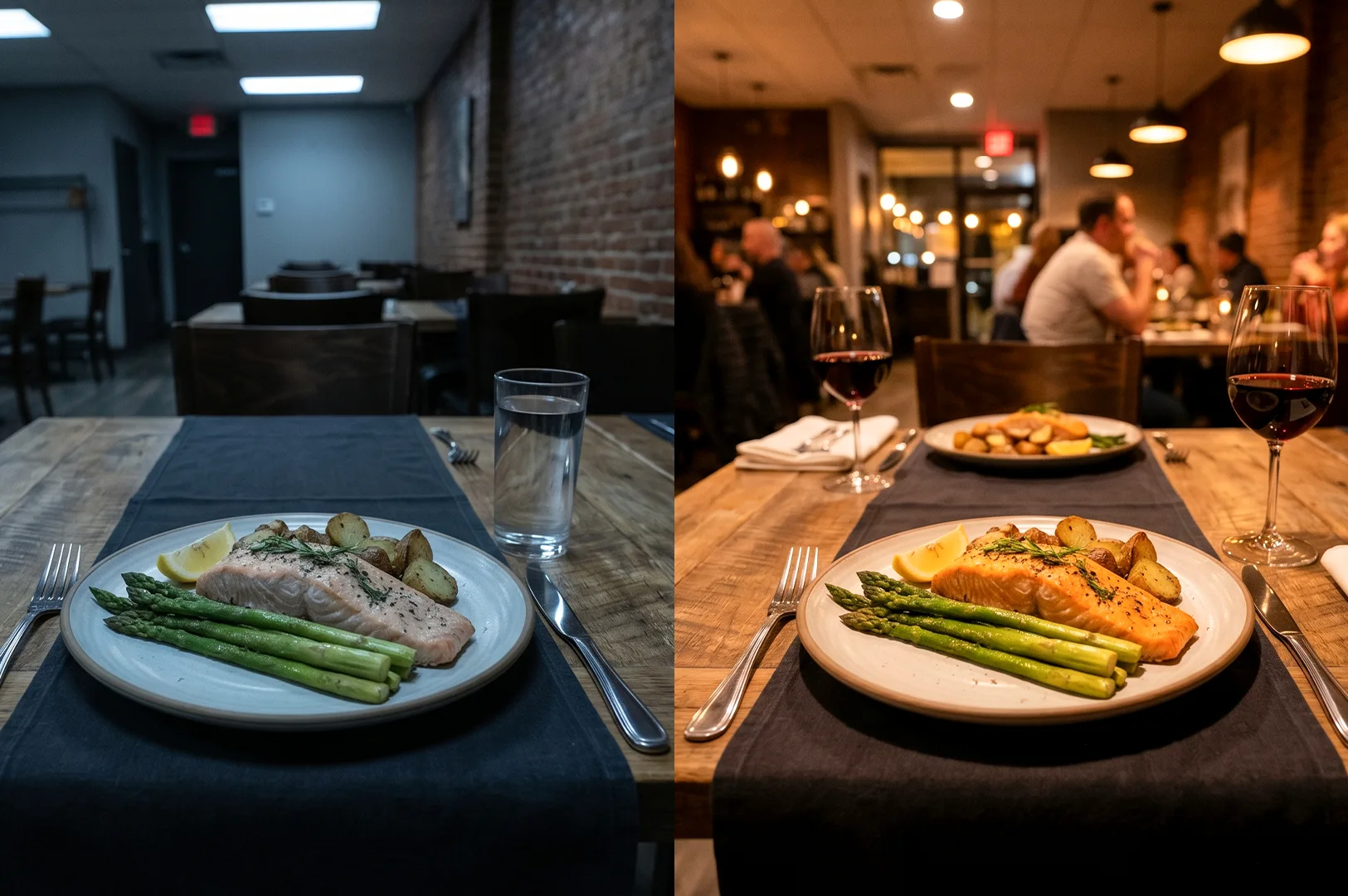

Most restaurant owners think lighting is a finishing touch. It is not. It is one of the most powerful sales tools in your entire space.
In Singapore, where diners are visually driven and phone cameras are always out, lighting can make your food look premium or forgettable. It can make your guests feel relaxed or restless. It can make a room feel warm and full or sterile and empty. Lighting does not just help people see. It tells people how to feel.
If your dinner sales are weaker than expected, look up.
A common mistake is using the same colour temperature everywhere. Cool white lighting might be fine in a prep kitchen, but in a dining area it can make skin tones look pale and dishes look flat. Warm lighting is usually better for comfort and appetite, but if it is too dim, your menu becomes hard to read and guests get annoyed. The answer is not “bright” or “dark.” The answer is layered lighting.
You need at least three layers:
- Ambient lighting for overall comfort
- Task lighting for tables and service points
- Accent lighting for focal areas like feature walls or plating counters
When these layers are balanced, your space feels intentional. When they are not, the room feels accidental.
Another issue is glare. In many renovated restaurants, decorative pendants look beautiful but shine directly into guests’ eyes. This creates discomfort that people rarely complain about, but they feel it. They order less, leave faster, and do not come back for long conversations. Discomfort reduces average spend.
Then there is the reflection problem. Glossy tabletops, mirrored walls, and polished tiles can bounce light unpredictably, creating visual noise. In photos, this causes blown highlights. In person, it creates a subtle stress response. Good lighting design controls reflection as much as brightness.
Singapore’s daylight conditions also matter. If your restaurant receives strong afternoon sun, your interior lighting must adapt. Otherwise, half your dining room looks overexposed while the other half feels gloomy. This is why dimmable circuits are not a luxury. They are a basic operational requirement.

From a branding perspective, lighting should match your concept. A modern izakaya, a heritage kopitiam-inspired space, and a minimalist café should not share the same lighting strategy. Yet many do, because lighting is often decided too late, after furniture and finishes are locked. By then, your options are limited and expensive.
The best time to plan lighting is during layout development, not after carpentry. You want to coordinate ceiling points with table positions, service routes, and camera-friendly angles. This is especially important if your business depends on user-generated content. Diners will post what looks good. If your lighting makes every plate look dull, your marketing engine slows down.
For technical guidance, the Building and Construction Authority (BCA) in Singapore offers resources on sustainable and efficient lighting in commercial spaces, including energy performance considerations.
Do not underestimate the psychological effect of a well-lit room. People stay longer in spaces that feel flattering. They order more when food looks vibrant. They remember places that feel comfortable at every table, not just the one near the window.If your lighting is wrong, your food has to work twice as hard. Fix the light, and your sales often improve without changing a single dish. Learn more in: Restaurant Lighting Design Guide: From Ambient to Accent Illumination.